
For millions seeking salon-smooth skin at home, hard wax (or hot wax) kits promise professional results without the professional price tag. Yet, a quick scan of online reviews and beauty forums reveals a recurring chorus of frustration. Consumers lament products that are "too stringy," "impossible to peel," or worse, cause painful burns. These complaints are almost universally directed at the wax itself, branded as faulty or low-quality. However, a consensus from leading skincare experts and professional estheticians points to a different, far more common villain: improper temperature control.
Decoding the Complaints: Symptom vs. Root Cause
The customer complaints follow a predictable pattern, each directly linked to a specific temperature failure:
❌ “The wax is too stringy / extremely sticky” & “The wax doesn’t dry / dries too slowly”
✅ Actual Cause: Temperature too low. When hard wax is underheated, it doesn't achieve a complete melt. The polymers and resins remain partially solidified, creating a thick, paste-like consistency. This paste is inherently "stringy" and lacks proper adhesion. Because it's not fluid enough to form a thin, even film, it takes an excessively long time to dry and set on the skin. The resulting layer is weak and lacks cohesion, making a clean, one-piece removal nearly impossible. It tears, fractures, and leaves behind a sticky, frustrating mess.
❌ “The wax is too hard / not sticky enough”
✅ Actual Cause: This is a dual-failure scenario often stemming from temperature too low, followed by overcompensation. A user finds the wax too stringy, so they heat it further. If they then apply it while it's still too hot (thin and runny), it spreads into a layer that is too thin to properly encapsulate hairs. This thin layer then cools and hardens rapidly on the skin, feeling "too hard" and failing to grip the hair effectively ("not sticky enough"). The problem wasn't the wax's inherent tackiness, but its inability to form a properly thick, pliable film due to incorrect thermal application.
❌ “Burns the skin”
✅ Actual Cause: Temperature too high. This is the most serious and painful error. Overheated wax becomes dangerously thin and its thermal capacity increases. Applied to the skin at this state, it can cause first-degree burns, redness, and heightened sensitivity. The risk is exacerbated by low-quality, unregulated warmers that have inaccurate thermostats or severe hot spots.
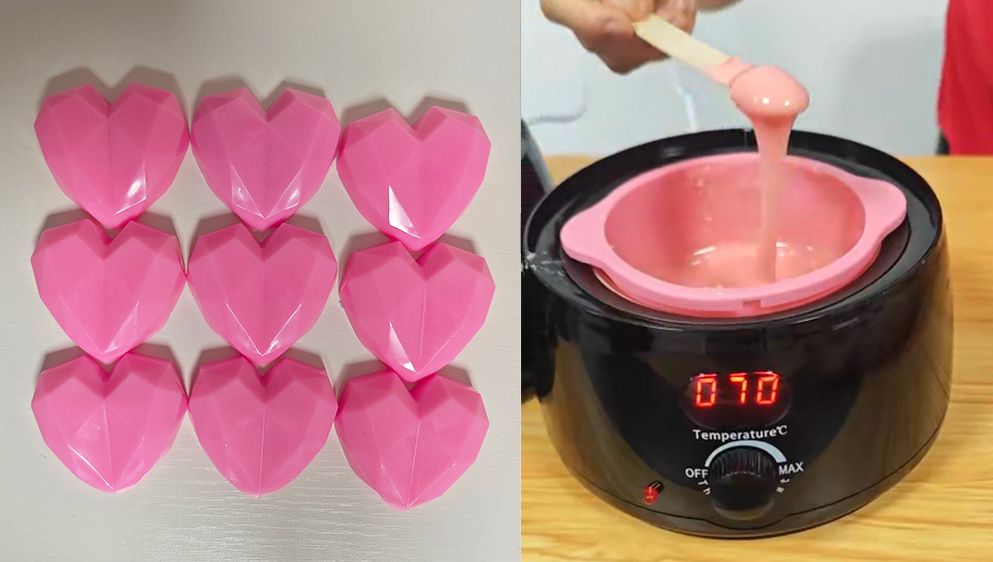
The Technology Trap: Why Your Warmer Might Be Lying to You
A significant part of the problem lies in the equipment. "Many consumers start with inexpensive, low-wattage warmers or even use makeshift methods like microwaves," explains David Chen, a product engineer specializing in personal care devices. "These provide inconsistent, uneven heat. Even budget 'temperature-controlled' warmers can have a variance of +/- 5°C or more. The wax at the top might be perfect, while at the bottom it's a solidified pool, and near the heating element it's scalding hot."
This inconsistency creates an unpredictable user experience, directly fueling the perception of an unreliable product.
The Professional's Prescription: The Golden Rules of Wax Temperature
Transforming a home waxing disaster into a salon-quality result is achievable by adhering to a few professional protocols.
Invest in a Precision Tool: The first step is to upgrade from a basic warmer to a digital, thermostatically controlled wax warmer. Look for models that allow precise temperature adjustment (in 1°C increments) and have a reputation for even heat distribution. This single investment is more critical to success than frequently switching wax brands.
Master the "Drip Test" – The Non-Negotiable Check: Before any wax touches your skin, perform the universal professional test.
Method: Use a clean, wooden spatula (never metal, as it conducts heat). Dip it into the melted wax, pull it out, and hold it horizontally about 5-10 cm above the pot.
The Perfect Consistency: The wax should drip off slowly and steadily, forming a thick, honey-like stream. The "tail" of the drip should stretch about an inch before cleanly breaking. This indicates the ideal viscosity: fluid enough to spread easily, but thick enough to build a strong, flexible layer.
Too Cold: It will barely drip, cling in globs, or form long, stubborn strings.
Too Hot: It will drip rapidly, like water or thin oil.
The "Wrist Test" – The Final Safety Check: After passing the drip test, always apply a small, pea-sized amount to the inside of your wrist. This skin is sensitive and provides an accurate gauge. The wax should feel warm and soothing, never hot or painful. It should also cool and set within the expected time frame (usually 30-45 seconds for body wax).
Conclusion: A Paradigm Shift in Home Grooming
The narrative surrounding home waxing failures needs to shift. The evidence is clear that most "quality issues" are, in fact, "technique issues" centered on temperature. By understanding the science behind hard wax—a temperature-activated polymer—and adopting the simple, professional-grade checks of the Drip Test and Wrist Test, consumers can reclaim control. The goal is not to find a mythical "perfect wax," but to learn how to unlock the perfect state of the wax you have. In the world of hard wax, precision heat isn't just a detail; it's the fundamental key to a clean, safe, and effective result.